
TMS Therapy for OCD in Glendale, CA
BrainsWay Deep TMS is FDA-cleared for obsessive-compulsive disorder. At Breakthrough TMS in Glendale, we deliver it with a specialized coil and protocol designed to target the neural activity involved in compulsive loops, noninvasive, in-office, and built to fit into daily life.
Medically reviewed by Artur Saakyan, MD
When OCD Does Not Respond to Standard Treatment
Obsessive-Compulsive Disorder (OCD) is more than intrusive thoughts. It can consume time, disrupt routines, and create constant mental pressure. If OCD has not improved enough with therapy and medication, Deep TMS may be an option. It works through a different mechanism than either, using targeted magnetic stimulation rather than talk or medication. If you are comparing approaches, this overview of what TMS is explains the differences.
What OCD Can Look Like
- Intrusive thoughts that feel impossible to shut off
- Repetitive behaviors or mental rituals to reduce anxiety
- Fear of contamination, harm, or “something bad happening”
- Checking, counting, repeating, or seeking reassurance
- Significant time lost each day and reduced quality of life
Why Deep TMS for OCD
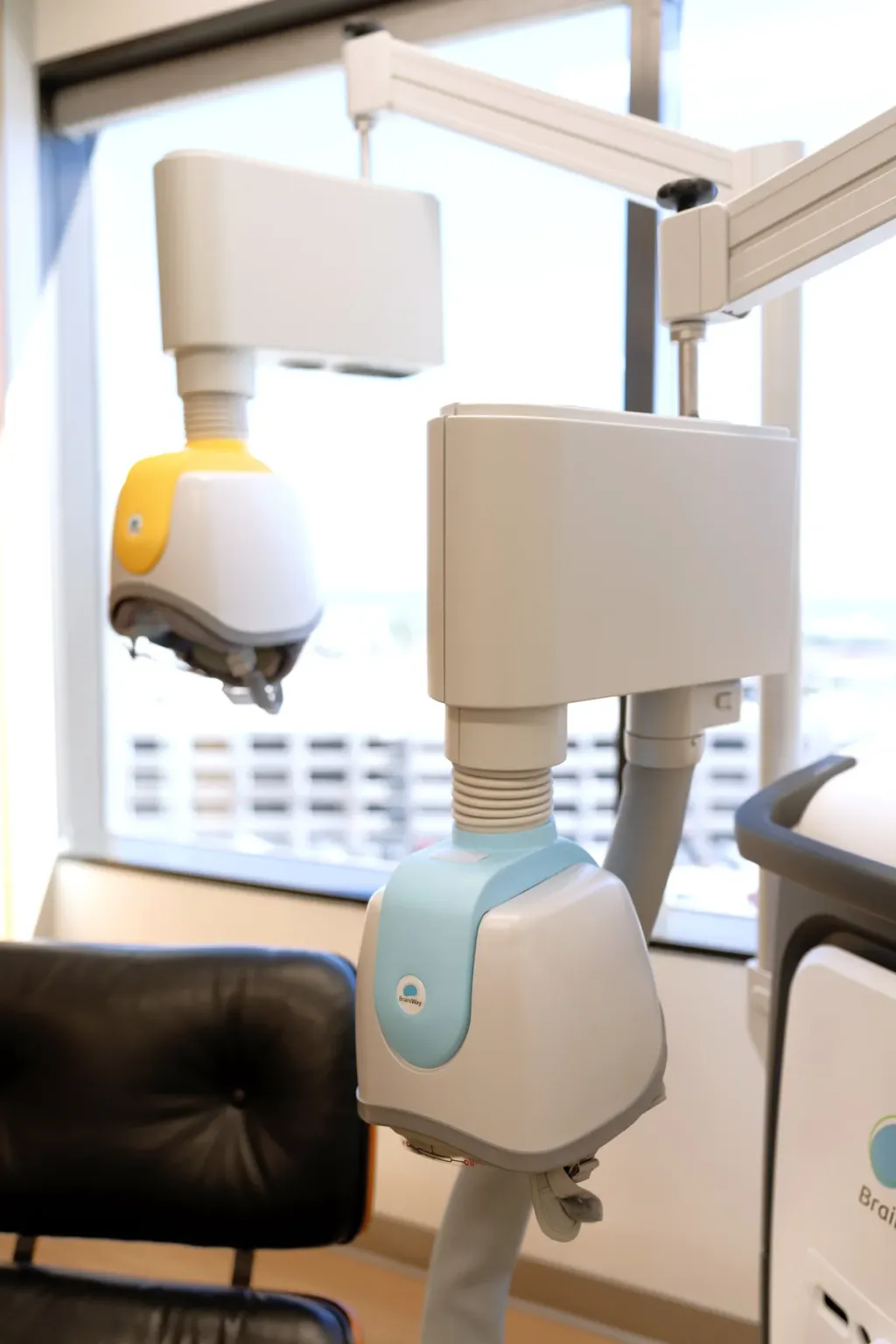
BrainsWay Deep TMS for OCD uses a specialized coil (the H7) and a protocol designed to target neural activity involved in compulsive loops, including areas in the medial prefrontal and cingulate networks. Treatment is non-invasive, performed in-office, and designed to fit into daily life.
What to Expect During Treatment
OCD protocols often include a brief, guided activation step before stimulation (sometimes called provocation) to engage the relevant circuitry, followed by a short treatment session. Provocation is personalized to your specific triggers, and it is designed to be tolerable, not overwhelming. Your plan is built around your symptoms, history, and tolerance.
Sessions themselves follow the same rhythm as other TMS treatment: you sit in a treatment chair, wear the helmet that positions the coil, stay awake throughout, and return to your day afterward. See the full session walkthrough here.
What a Course of Deep TMS for OCD Involves
An OCD course is a schedule, not a single appointment. In the multicenter trial that supported FDA clearance, patients received daily weekday treatment across six weeks, and that is the shape of the course we deliver here.
Before the first treatment, your provider maps your motor threshold, a short calibration that finds the right coil position and the right stimulation intensity for your anatomy, rather than a generic setting. That mapping is re-checked through the course, because the correct intensity is not a fixed number for the length of treatment.
Each visit after that follows the same rhythm: a brief, personalized provocation to engage the circuitry, then the stimulation itself. You are in and out in well under an hour, awake throughout, and free to drive yourself home and go back to work, school, or anything else you had planned. The repetition is the point, the protocol is built on consistent daily stimulation, so the biggest practical question for most patients is not whether they can tolerate a session but whether they can protect the same slot on the calendar for six weeks. Our office runs 7:00 AM to 7:00 PM on weekdays specifically so that slot exists.
How the OCD Protocol Differs From the Depression Protocol
These are genuinely different treatments delivered by the same system, and the differences are not cosmetic:
- A different coil. OCD is treated with the H7 coil. Depression is treated with the H1. We own both, so the coil is chosen for your diagnosis rather than by what happens to be on the machine.
- A different target. The OCD protocol stimulates the medial prefrontal cortex and anterior cingulate cortex, the circuitry implicated in compulsive loops. The depression protocol targets prefrontal regions associated with mood.
- A provocation step. OCD sessions begin with a brief, individualized symptom provocation. Depression sessions have no equivalent step.
- A different course length. The OCD course in the pivotal trial ran six weeks of weekday sessions. Depression protocols vary, and one FDA-cleared option, accelerated Deep TMS, condenses the core course into six treatment days. That accelerated protocol is cleared for major depressive disorder only, so it is not part of OCD care here.
What Response Looks Like, and Over What Timeframe
Response in OCD is measured, not guessed at. The standard instrument is the Yale-Brown Obsessive Compulsive Scale (Y-BOCS), scored at intake and re-scored through your course, and the conventional threshold for calling someone a responder is a reduction of at least 30% in that score.
In the pivotal multicenter trial, response was assessed at the end of the six-week course and again a month later. At the end of treatment, 38.1% of patients who received active Deep TMS met that response threshold, compared with 11.1% of patients who received a sham treatment. At the one-month follow-up the figures were 45.2% and 17.8%, meaning the difference between real and sham stimulation held after treatment stopped, and that some patients kept improving in the month after their last session.
Read those numbers for what they are: results from a trial population, not a forecast for you. They are the reason Deep TMS is a reasonable option to consider when OCD has not responded adequately to medication and therapy, and they are also why candidacy is screened carefully before treatment starts. Individual results vary, your own trajectory is tracked on the Y-BOCS rather than on impressions, and we will tell you plainly if the scores are not moving. You will always know where you stand, and the decision stays yours.
Source: Carmi L, Tendler A, Bystritsky A, et al. Efficacy and Safety of Deep Transcranial Magnetic Stimulation for Obsessive-Compulsive Disorder: A Prospective Multicenter Randomized Double-Blind Placebo-Controlled Trial. Am J Psychiatry. 2019;176(11):931–938. doi:10.1176/appi.ajp.2019.18101180
Wondering how a six-week course is paid for? Our team verifies your benefits before treatment begins, see insurance and benefits verification. Coverage and candidacy vary by diagnosis, insurance plan, and clinical evaluation.
Are You a Candidate for TMS?
You may be a fit if you:
- Have OCD that remains disruptive despite standard treatment
- Want a non-drug option that targets brain circuitry
- Are medically appropriate after screening
Safety & Side Effects
The most common side effects are temporary scalp discomfort or headache, and comfort typically improves as your body adapts. We go over safety, and anything that would make TMS a poor fit for you, during your consultation, including screening for metal in or around the head.
Cost & Insurance
Coverage varies by plan. We will help you understand benefits and out-of-pocket expectations before starting. Contact our Glendale office and we will verify your plan.
OCD FAQs
Is Deep TMS for OCD FDA-cleared?
Yes. BrainsWay Deep TMS is FDA-cleared for OCD.
What is the H7 coil, and why does it matter for OCD?
The H7 coil is BrainsWay’s Deep TMS coil used for OCD protocols. It is designed to stimulate brain regions involved in OCD loops, including areas in the medial prefrontal and cingulate networks.
What is “provocation,” and why do you do it before treatment?
Provocation is a short, personalized exposure that brings up your specific OCD triggers before stimulation. It is used to activate the relevant brain circuitry so the protocol can target the right networks more effectively.
What does provocation look like in real life?
It can be a script, images, or a simple activity tailored to your triggers. It is brief, guided, and designed to be tolerable, not overwhelming.
Will I be awake during treatment?
Yes. You stay awake the entire time, TMS does not require anesthesia or sedation, and most patients return to normal activities right after a session.