
What Is TMS? Transcranial Magnetic Stimulation Explained
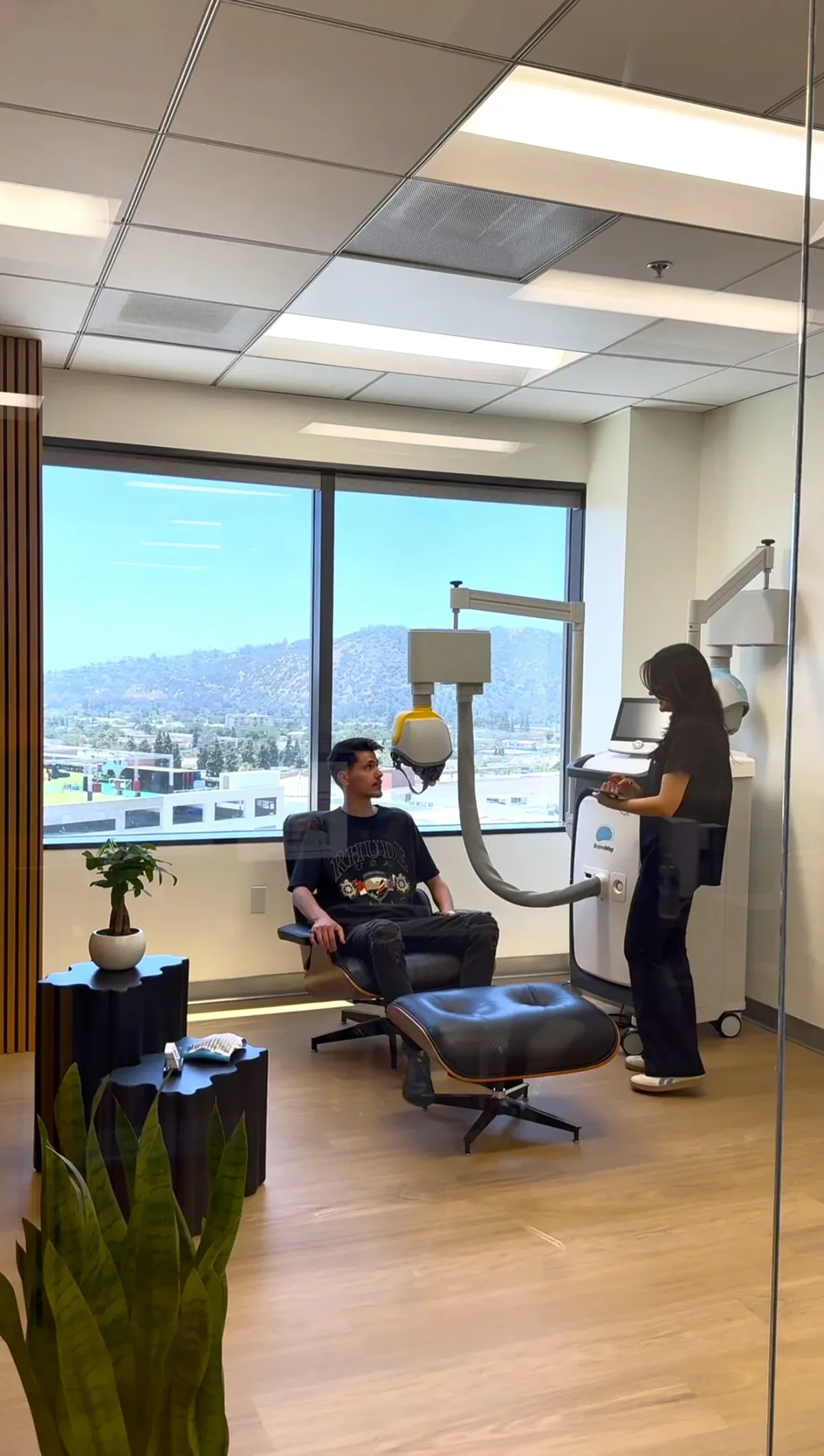
Transcranial Magnetic Stimulation (TMS) is a non-invasive treatment that uses magnetic pulses to stimulate specific brain networks. It is performed in-office while you are awake, and it does not require anesthesia, sedation, or a hospital stay. At Breakthrough TMS in Glendale, we provide TMS using BrainsWay Deep TMS technology.
Medically reviewed by Artur Saakyan, MD
Why Stimulating the Brain Can Help
Many mental health symptoms are linked to patterns of underactivity or dysregulation in specific brain circuits. Rather than working through your whole body the way medication does, TMS delivers repeated magnetic stimulation directly to those networks, helping them function more normally over time.
That is why TMS is delivered as a course of sessions rather than a single visit: the change builds gradually as sessions accumulate, the way repetition strengthens any pattern.
There is also nothing to come off at the end. Because TMS is not a drug, finishing a course does not involve tapering a medication or the discontinuation symptoms that stopping one can bring. Some patients notice changes during the course, and others continue to build improvement after the final session.
TMS Coil Comparison
Depth and treatment coverage across TMS coil types
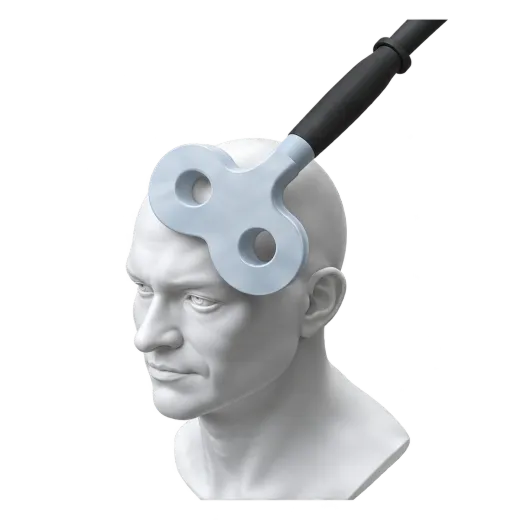
Traditional Figure 8 Coil
for Major Depressive Disorder (MDD)
- Depth:
- 0.7 cm subdural
- Volume:
- 3 cm³
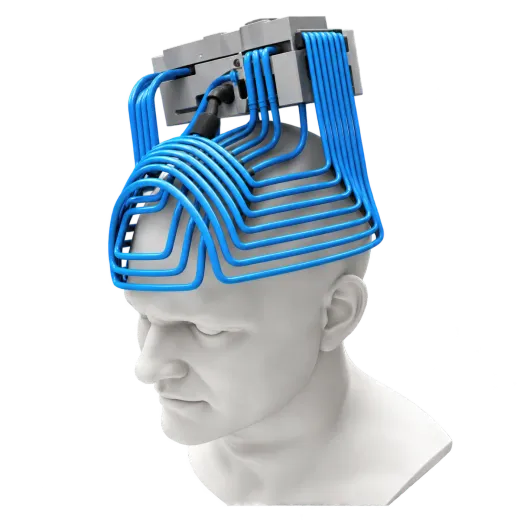
H1-Coil
for Major Depressive Disorder (MDD)
- Depth:
- 1.8 cm (2.5× deeper)
- Volume:
- 18 cm³
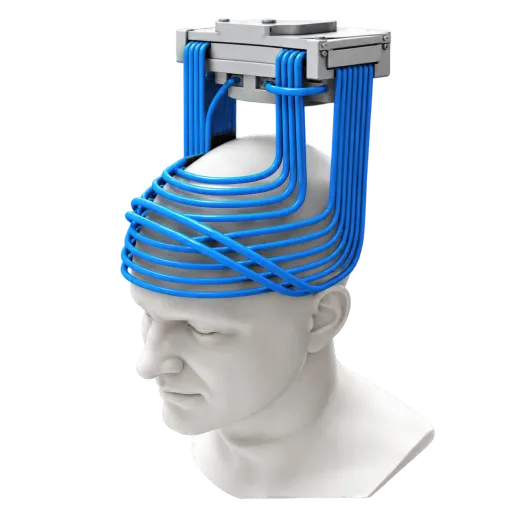
H4-Coil
for Smoking Cessation
- Depth:
- 1.5 cm (2.1× deeper)
- Volume:
- 15.2 cm³
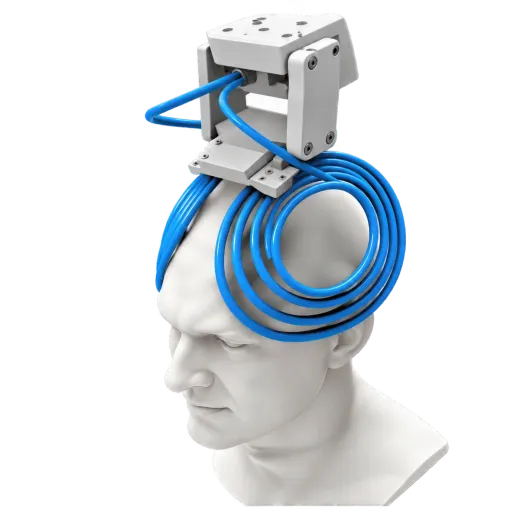
H7-Coil
for Obsessive-Compulsive Disorder (OCD)
- Depth:
- 3.0 cm subdural (4× deeper)
- Volume:
- 40.3 cm³
At 120% of motor threshold, the standard depression protocol, the H1 coil produces supra-threshold stimulation to a depth of 1.8 cm, compared with 0.7 cm for a standard figure-8 coil.
Source: BrainsWay, An In-Depth Look at Deep TMS, citing Roth Y, et al. Three-dimensional distribution of the electric field induced in the brain by transcranial magnetic stimulation using figure-8 and deep H-coils. J Clin Neurophysiol. 2007;24:31–38. Figures apply at 120% of motor threshold and are not fixed properties of the hardware. Breakthrough TMS owns the H1, H4 and H7 coils.
Broad coverage means your results do not depend on perfect aim.
A traditional figure-8 coil is a small handheld device that has to be positioned precisely and held there. Not once, but across every session in the course, and your head cannot move during any of them. A shift in posture or a slight change in coil angle moves the pulse off target.
The H-coil sits in a cushioned helmet that can only be worn one way. It positions itself and it stays put. Patients move freely, watch TV, use their phone, or talk with us, and the treatment lands the same way every session.
The H-coil also covers a far wider area of cortex than a figure-8 coil. A broader field is inherently more forgiving of small differences in placement, which is why consistency here is built into the equipment instead of depending on a steady hand.
Depth is what lets us treat OCD.
A figure-8 coil reaches about 0.7 cm into the cortex. The H7 coil reaches 3.0 cm. That difference is not "better" in the abstract. It is what makes the medial prefrontal and anterior cingulate regions reachable at all, and those are the regions that matter in OCD.
Who May Consider TMS
TMS is often considered when standard treatments have not brought enough relief. You may be a candidate if any of these describe you:
- You have been diagnosed with a condition where therapy alone has not provided adequate relief
- You have had limited success with medication, or side effects you found intolerable
- You are looking for a long-term option that is not a drug
TMS is not right for everyone. It is not appropriate for people with non-removable metallic implants on or near the head, and a history of severe seizure disorders also rules it out. Standard dental fillings do not count and are not a barrier. Eligibility is confirmed through clinical evaluation and safety screening.
At our Glendale clinic, we use FDA-cleared Deep TMS protocols for specific conditions, most commonly depression that has not responded to medication, obsessive-compulsive disorder (OCD), anxious depression, late-life depression, and smoking addiction. Most of the people we treat are adults; see our overview of adult TMS therapy in Los Angeles.
Where the Research Is Still Developing
Deep TMS is being studied for conditions beyond its current FDA clearances. Published research is growing for migraine, tinnitus, and post-traumatic stress disorder. These uses are not FDA-cleared, and we do not advertise them as services.
If you are being treated here for a cleared indication and one of these conditions is also part of your picture, it is a reasonable thing to raise with Dr. Saakyan during your evaluation. Whether TMS has any role is a clinical judgment made case by case, not something we can answer in advance.
How Effective Is Deep TMS?
Deep TMS is an evidence-based treatment for depression, including depression that has not improved enough with antidepressant medication.
A 2024 systematic review pooled five randomized controlled trials of Deep TMS in adults whose depression had not responded to multiple medications, covering 507 patients. Among those receiving active Deep TMS, 45.3% responded, meaning their symptoms improved by at least 50%, and 38.3% reached remission. In the control groups the figures were 24.2% and 14.4%.
Individual results vary, and no treatment can guarantee response or remission. Whether Deep TMS is appropriate for you is decided after evaluation and safety screening.
Source: Lan XJ, Yang XH, Mo Y, et al. Deep transcranial magnetic stimulation for treatment-resistant depression: a systematic review and meta-analysis of randomized controlled studies. Asian J Psychiatr. 2024;96:104032. doi:10.1016/j.ajp.2024.104032
How TMS Compares to Other Treatments
TMS works differently than most common treatments because it targets specific brain networks using magnetic stimulation, without medication or anesthesia, and without a hospital stay.
Compared to antidepressants: TMS is not systemic, so it avoids many whole-body side effects. It is delivered as a defined course of in-office sessions rather than a daily drug routine.
Compared to ketamine: TMS is non-drug and does not involve dissociation. It is designed to create steady, durable change by strengthening mood-regulation networks over time.
Compared to electroconvulsive therapy (ECT): TMS does not require anesthesia and does not induce a seizure, and most patients return to normal activities immediately after each session.
TMS Safety Overview
TMS is widely used and generally well-tolerated. The most common side effects are temporary, such as mild headache or scalp discomfort, and they tend to ease as your body adapts to treatment. Safety screening before starting is essential, especially for patients with metal in or around the head, which can make treatment inappropriate. We walk through all of this with you before anything is scheduled.
Curious what a visit actually looks like? Read about the TMS treatment process, mapping, session length, and what treatment feels like.
Is TMS safe? What about seizures?
Seizures are rare.
Published incidence for repetitive TMS is under 0.1%, compared with 0.35% to 0.44% for the antidepressant bupropion.
Motor threshold is re-checked through treatment, seizure-trained staff are always present, and a prevention checklist is completed at every visit.
Source: Trapp NT, Purgianto A, Taylor JJ, et al. Consensus review and considerations on TMS to treat depression: a comprehensive update endorsed by the National Network of Depression Centers, the Clinical TMS Society, and the International Federation of Clinical Neurophysiology. Clin Neurophysiol. 2025;170:206–233. doi:10.1016/j.clinph.2024.12.015
TMS Safety FAQ
What are common side effects of TMS?
Side effects are typically mild and temporary. Some people experience headache or scalp discomfort during or after sessions, and this usually eases as the body adapts to treatment.
For the nerds: frequencies, targets, and coils
TMS delivers magnetic pulses to targeted neural pathways. Delivered repeatedly, this produces lasting shifts in cortical excitability consistent with synaptic plasticity, propagating transsynaptically to connected limbic and subcortical structures. All three cleared protocols are high-frequency and therefore excitatory. In each case the target is a cortical region that is under-regulating, rather than a region that needs suppressing.
MDD. 18 Hz to the left dorsolateral prefrontal cortex via the H1 coil. Prefrontal hypoactivity is a consistent finding in depression, and stimulation there propagates to subgenual cingulate and limbic structures, restoring top-down regulation rather than acting on any single neurotransmitter system.
OCD. 20 Hz to medial prefrontal cortex and anterior cingulate via the H7 coil. The target is cortical control over the cortico-striato-thalamo-cortical loop implicated in obsessions and compulsions, circuitry a figure-8 coil over DLPFC does not reach. The mPFC target also overlaps default mode network nodes implicated in the perseverative quality of obsessions. Each session follows individualized symptom provocation.
Smoking cessation. 10 Hz to bilateral lateral prefrontal cortex and insula via the H4 coil. The insula is a salience network hub that assigns motivational weight to interoceptive craving states, and it is not reachable with a figure-8 coil, which is what made this indication possible on an H-coil. Each session follows a cue-induced craving procedure.
Across OCD and smoking cessation, stimulation is delivered while the target circuit is active rather than at rest.
Sources: Levkovitz Y, Isserles M, Padberg F, et al. Efficacy and safety of deep transcranial magnetic stimulation for major depression: a prospective multicenter randomized controlled trial. World Psychiatry. 2015;14(1):64–73. · Carmi L, Alyagon U, Barnea-Ygael N, Zohar J, Dar R, Zangen A. Clinical and electrophysiological outcomes of deep TMS over the medial prefrontal and anterior cingulate cortices in OCD patients. Brain Stimul. 2018;11(1):158–165. · Carmi L, Tendler A, Bystritsky A, et al. Efficacy and safety of deep transcranial magnetic stimulation for obsessive-compulsive disorder: a prospective multicenter randomized double-blind placebo-controlled trial. Am J Psychiatry. 2019;176(11):931–938. doi:10.1176/appi.ajp.2019.18101180 · Zangen A, Moshe H, Martinez D, et al. Repetitive transcranial magnetic stimulation for smoking cessation: a pivotal multicenter double-blind randomized controlled trial. World Psychiatry. 2021;20(3):397–404. · Roth Y, Amir A, Levkovitz Y, Zangen A. Three-dimensional distribution of the electric field induced in the brain by transcranial magnetic stimulation using figure-8 and deep H-coils. J Clin Neurophysiol. 2007;24:31–38.
See if TMS Is Right for You
Get a Clear Answer in One Consultation
We will review your symptoms, treatment history, and safety factors, then explain whether TMS fits your needs and which FDA-cleared option may apply.
Schedule ConsultationSchedule Consultation